What to wear for husky sledding in Tromsø
You do not need to own Arctic gear for a husky tour from Tromsø, because every kennel on this site hands out a warm suit and winter boots. What you wear under the suit decides how the ride feels. Sitting still in the sled basket is the cold part, and it is the part most people dress for too lightly.
What the kennels hand out
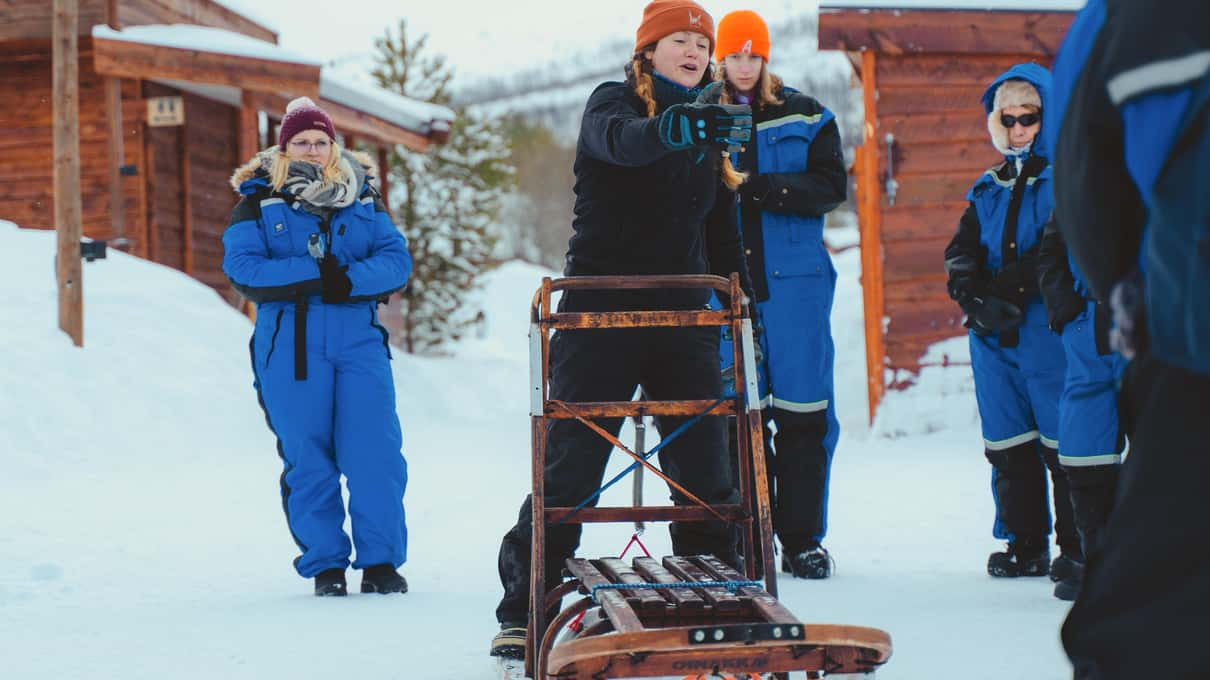
All six main husky tours on this site include a warm outer suit and winter boots, along with the bus from town. The suit is a one-piece overall that zips over your own clothes, and the boots are big insulated ones with room for a thick sock. Beyond that the listings differ a little, so the table sums up what each one promises.
| Tour | From | Clothing in the listing |
|---|---|---|
| Breivikeidet short ride | ~$228 | Warm suit and boots |
| Breivikeidet self-drive | ~$301 | Thermal suit, boots, mittens and a hat |
| Our pick, Kvaløya self-drive | ~$349 | Suit and winter boots, with wool socks and mittens (plus a hat) if you need them |
| Wilderness Center guided ride | ~$352 | Warm clothes and boots |
| Wilderness Center self-drive | ~$353 | Warm suit and boots |
| Tamok valley day trip | ~$353 | Thermal suit, boots, mittens and a hat |
Borrowed mittens and hats do the job, but fit is luck of the draw. If you own warm mittens and a wool hat that covers your ears, bring them anyway. The suits are usually handed out at the kennel, so you ride out on the bus in your own clothes and change once you arrive.
Layers under the suit
Think of the borrowed suit as a windproof shell. It stops the breeze from a moving sled, but it does not keep you warm on its own, so the layers underneath do the real work.
- Base layer. A long-sleeved thermal top and long johns in merino wool or a synthetic fabric. Cotton holds sweat and turns cold the moment you stop moving.
- Middle layer. A wool sweater or a fleece jacket. Leave a thick down parka behind if you can, because it barely fits inside a suit.
- Legs. Long johns under fleece pants or other warm trousers. Jeans go stiff in the cold and make it hard to bend your knees on the runners.
- Socks. One pair of thick wool socks. Two pairs squeezed into a boot press on the blood flow and leave your toes colder.
- Neck and face. A buff or neck gaiter you can pull up over your nose when the wind bites.
- Head. A thin wool hat or balaclava that sits snugly over your ears and still fits under a second hat.
The bus out is heated, and open fires burn in the lavvo tents and huts where the tours serve hot drinks. Layers that open with a zip let you cool down indoors without undressing completely.
Driver or passenger, two different temperatures
On a self-drive tour you share a sled with a partner. One of you stands on the runners and drives while the other sits low in the basket, and you swap during the ride. The driver works the whole time and soon feels warm. Braking on the descents keeps you busy, and so does stepping off to push up slopes. The passenger sits still in the wind, close to the snow the dogs throw up, and cools down quickly.
Dress for the passenger seat, then open a zip when you take over the handlebar. On the guided ride at ~$352 a musher drives and you sit for about 45 minutes, so that ride rewards an extra layer more than any other. On the self-drive adventure from ~$349 you spend 70–80 minutes on the trail with several swaps, and both of you take turns at each temperature. Self-drive or passenger compares the two set-ups in more detail.
Where you sled matters too. The coastal kennels on Kvaløya and in Breivikeidet usually sit a few degrees below freezing, while the inland Tamok valley can drop to -20 °C (-4 °F) or below on a cold day. Our guide to the kennel locations shows which tour goes where.
Hands and feet
Fingers suffer first. You hold the handlebar for long stretches, and a cold grip draws heat out through thin gloves fast. Mittens keep fingers warmer than gloves because the fingers share their heat. A pair of thin liner gloves underneath means you can pull a mitten off for a photo without bare skin touching anything cold. Chemical hand warmers tucked into the mittens last for hours, and outdoor shops in central Tromsø sell them.
For feet, the kennel boots handle the snow, so your part is the sock. Bring good wool socks that fit without wrinkles, and lace the borrowed boots snugly without strangling your ankles. Wiggle your toes on the runners now and then. Standing on the brake keeps one foot still for a long time, and that is when feet chill. Our first-timer's guide explains how the brake works and how often you will use it.
Mittens and wool socks on loan
Our pick is the Kvaløya self-drive tour from ~$349. It lends a suit and winter boots to everyone. Anyone who arrives without wool socks and mittens (or a hat) can borrow those too. Afterwards you thaw out with hot drinks and cake beside the fire in a Sami lavvo.
Protecting eyes and skin
A team of dogs kicks up snow, and the air rushing at you on a downhill stretch makes the eyes water. Ski goggles solve both problems. In the bright weeks of March, sunglasses do a similar job while cutting the glare off the snow. During the polar night, from about late November to mid-January, the light is a soft twilight and dark lenses only get in the way. Our month-by-month guide describes how the light changes across the season.
Glasses fog up as soon as you pull a neck gaiter over your nose, because warm breath rises behind the lenses. Pull the gaiter below your nose while you drive, or wear contact lenses if you have them. Cold air dries skin and lips within an hour, so a stick of lip balm and a rich face cream earn their place in a pocket.
Batteries in the cold
Cold empties batteries. A phone that showed 80 percent at breakfast can die halfway along the trail, so keep it in an inside pocket against your body and carry a small power bank. Use a wrist strap or a lanyard, since a phone dropped from a moving sled vanishes into the snow behind you and the team will not wait while you look for it. Most people manage photos with a thin liner glove and pull the mitten back on between shots.
Big camera kit is awkward on a sled. Arctic Adventure Tours says tripods barely fit on its sleds, so it offers to keep them in its equipment room. Drones are not allowed there. The photography guide covers settings and which seat gives the better pictures.
Dressing from a cruise cabin or a hotel
Many readers walk off a ship with whatever they packed at home. That is usually fine, since the kennel supplies the suit and boots. Put on every thermal layer you brought before you leave the cabin, and bring mittens even if you think the loaners will do. All the meeting points sit on or near the harbor, a few minutes on foot from the Prostneset berth. A ship at Breivika adds the shuttle or taxi ride into town, as covered in our guide to sledding on a port day.
The sidewalks around the harbor turn icy in winter. Slip-on ice grips for your own shoes make the walk safer, and they come off when you swap into the kennel boots. Hotel guests have an easier time, with a suitcase to raid and the chance to buy missing pieces in town the day before. Children lose heat faster than adults and need a closer eye, and our family guide covers what each tour expects from young guests.