Photographing your husky ride in Tromsø
A dog team running through snow is one of the great pictures of a northern winter, and it is hard to take from a bouncing sled. Most good shots come from the passenger seat and from the dog yard before the ride. A little planning for the cold does the rest.
Phone or camera on a moving sled
A husky sled is a lively platform. The runners bounce over ridges in the snow while the team changes speed, and the wind tugs at anything loose. A phone is the easier tool here. It fits in a chest pocket and works with one hand, and modern phones handle motion well in good light. A small camera with a fast shutter does better in the dim light of the polar night, but you need a free hand and a safe way to carry it.
Whoever is driving does not take pictures. On a self-drive sled the driver needs both hands on the handlebar and a foot ready for the brake, and a team can surge without warning. Leave the camera to the person sitting in the sled. Our first-time mushing guide explains how the brake works.
The passenger seat is the photo seat
On the self-drive tours, two people share each sled and swap, so each of you gets a turn with the camera. Our pick, Arctic Adventure Tours at ~$349, gives the longest ride among the half-day tours, 70–80 minutes on the trail with several swaps, which means several chances at the view over the team. The tours in Breivikeidet swap halfway, and the Wilderness Center self-drive gives about 45 minutes in a shared sled.
If pictures matter more to you than driving, the guided ride at ~$352 keeps you in the sled for the full 45 minutes behind a professional musher. The views run toward Balsfjord and Malangen. You share the sled with one or two other guests, so agree on who sits where before you set off. Self-drive or passenger compares the two kinds of tour in more detail.
Shoot low and wide from the sled. The line of dogs stretching ahead toward the horizon makes the classic frame. Fire off bursts rather than single shots, because only a few frames will come out sharp on a rough trail. Video often works better than stills here, since the motion is the whole point.
Photo stops and pictures by the guides
Of the main tours, only one lists a photo stop. On the Husky Experience at ~$228 in Breivikeidet, the team runs 10–15 minutes out at a slow pace and stops. The guide then takes your picture as a musher before you swap and head back. It is the shortest ride on the site, at most 30 minutes in total, but it is the one tour where someone else holds the camera for you.
On the other tours, ask the guide at the start whether there will be a pause on the trail. When the dogs rest, guides are usually happy to snap the two of you with the team. For the night, the All-in-One Night at ~$573 includes professional Northern Lights portraits, sent within 48 hours. Husky tours and the Northern Lights covers the evening options.
A musher's portrait for ~$228
The Husky Experience in Breivikeidet is the cheapest tour on the site. At the turning point the guide stops the team and photographs you on the runners, and there is time for dog yard cuddles afterward.
Cold hands and cold batteries
Cold drains batteries fast. A phone that shows a healthy charge in the hotel can shut down early at -10 °C (14 °F), and inland at Tamok the air can fall to -20 °C (-4 °F) or below. Keep the phone inside the kennel's suit, close to your body. Take it out only for the shot. A small power bank on a short cable helps, and a spare camera battery belongs in a warm pocket. Cruise passengers heading straight from the ship should charge everything in the cabin before going ashore.
Gloves are the other problem. Thick mittens make buttons impossible, and bare fingers go numb fast on a moving sled. Wear thin liner gloves under the mittens (touchscreen ones help with phones) and slip one mitten off for the picture. When you come in from the cold to a warm hut or lavvo, put the camera in a closed bag first and let it warm up slowly, which stops condensation fogging the lens. Our clothing guide covers mittens and layers.
Light through the season
The sun stays below the horizon through the polar night, roughly late November to mid-January. Around midday there are a few hours of blue and pink twilight. That soft light flatters snow and fur, yet it is dim, so phones raise the ISO and blur moving dogs. Shoot in the brightest hour you can and accept some grain.
Daylight comes back quickly in February, and March brings long, bright days with sun on the snow. Then the problem flips. Bright snow fools the camera into dull gray pictures, so dial in some exposure compensation or tap the snow on your phone screen to brighten the frame.
The backdrop depends on where you sled. The Breivikeidet camp has the Lyngen Alps behind its fields. The Tamok valley lies deep in the mountains, about 95 minutes from town. Our kennel guide compares the three areas, and the season guide covers the light month by month.
Wrist straps and tripods
Anything you drop from a sled stays behind in the snow, because the team will not stop for a phone. Use a wrist strap or a lanyard clipped to the suit. A camera can hang from a neck strap and live under the suit's zip between shots. A chest mount for a phone or action camera frees both hands and films the team from your point of view.
Tripods make little sense on the trail. Arctic Adventure Tours says there is little room on the sled for one, but you can leave it in the equipment room while you ride. A tripod earns its place later, at a camp after dark. Drones are another matter. Arctic Adventure Tours does not allow them, and a drone buzzing over a dog team can spook the dogs, so leave yours at the hotel whichever tour you book.
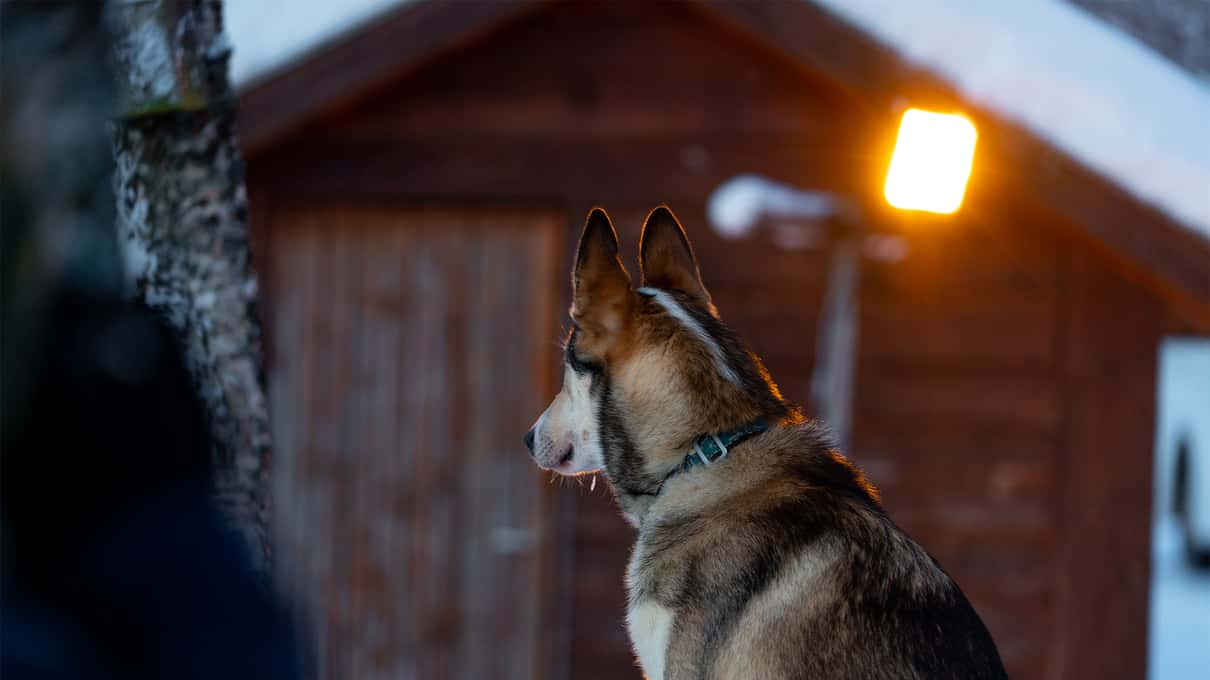
Faces at the kennel
Many of the best pictures happen standing still. On most tours there is time with the dogs before or after the ride, and the guided Wilderness Center ride includes a dog yard tour plus a puppy visit. Get down to the dogs' eye level and focus on the eyes. Then wait for the moment a dog looks up at you.
Harnessing time is loud and fast, and the teams need space. Stand where the guide puts you and ask before using a flash. Never step between dogs on a gangline. Inside the lavvo after the ride, the fire gives warm light for portraits of your group.
Dogs dozing in the doorway of their houses make quieter pictures than a team at full speed. Our page on husky welfare explains what you are seeing in the yard, and the family guide has tips for children meeting puppies.