Your first time driving a dog sled near Tromsø
Almost nobody on a husky tour from Tromsø has driven dogs before, and the tours are set up with that in mind. The skills fit into a ten-minute briefing. What surprises first-timers is how hard the dogs pull and how much work a small hill can be.
Nobody expects you to know how
The half-day tours around Tromsø are built for beginners. A guide explains the sled at the kennel, then drives the lead sled on a trail the dogs have run many times. You do not steer the team the way you steer a car. The dogs follow the sled in front, and your job is mostly to control the speed and stay on board.
That is why tours with thousands of reviews from first-timers still score 4.9/5. The only trip on our list aimed at people with some experience is the advanced tour at Camp Tamok, covered in our guide to the kennel areas. Everything below applies to the regular tours.
The parts of a sled
Kennels use slightly different sleds, but the basic layout is the same everywhere.
- Runners. Two long skids under the sled. The driver stands at the back with one foot on each.
- Handlebar. The bow at the back that the driver holds with both hands. It is the thing you hold on to whatever happens.
- Basket. The seat in front of the driver, where your partner sits wrapped up and low.
- Brake. A metal bar or claw between the runners. Step on it and its teeth dig into the snow. Many sleds also carry a rubber mat you can stand on with one foot for gentler slowing.
- Snow hook. A metal anchor on a line. Pushed into the snow, it holds the team in place during a stop. Your guide will tell you whether you need to use it.
- Gangline. The central line the dogs are clipped to in pairs. When it stays tight, the dogs pull straight and nobody gets tangled.
What the briefing covers
Before anyone steps on a runner, a guide walks the group through the sled and the rules for the trail. Expect a demonstration of the brake and advice on how far to stay behind the sled in front. The guides also show the signals they use when the whole group needs to stop.
The dogs are loudest at this moment. A team waiting to leave howls and leans into its harnesses, and newcomers often find the noise unnerving. Keep the brake pressed and both hands on the handlebar while the team is anchored. The dogs go quiet within a minute of starting, because running is what they wanted all along. Our welfare guide explains why Alaskan huskies behave this way.
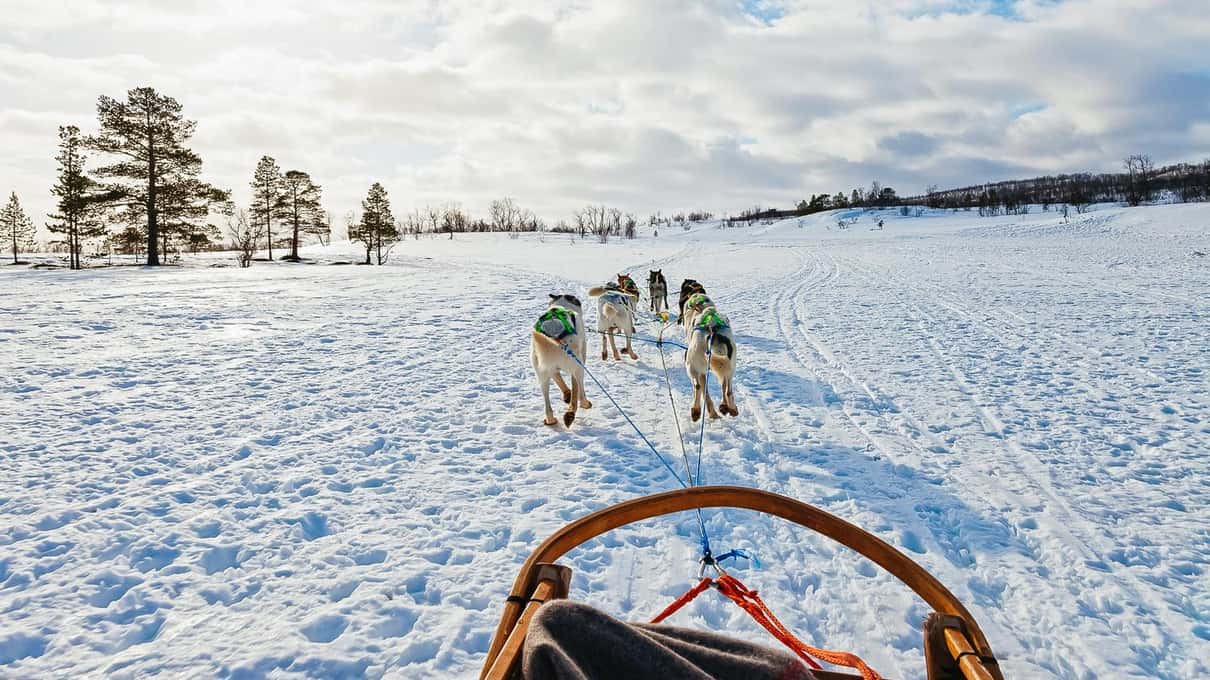
On the trail
Following the lead sled
A guide drives the first sled, and the teams behind follow it in a line. Your dogs know the routine and will chase the sled in front. Use the brake to hold the gap the guide asked for, so your team does not catch up with the sled ahead. On a descent, brake enough that the sled never overtakes your own dogs, which keeps the gangline tight.
Turns and balance
Bend your knees and keep them loose, as you would on a bumpy ski slope. In a bend, lean slightly toward the inside of the turn and put more weight on the inner runner, so the sled does not tip outward. Slow down before a sharp bend rather than in the middle of it. Passengers help by sitting still and leaning with the driver.
Pushing uphill
A team of dogs pulls two adults easily on the flat, but a climb is hard work for them. On uphill stretches the driver keeps one foot on a runner and pushes with the other, the way you ride a scooter. The other way is to step off and jog behind while holding the handlebar. The Breivikeidet listing says outright that you help push, and the Wilderness Center warns that you sometimes do. Pushing is the most tiring part of the day and the reason for the fitness rules below.
Gentle trails for a first drive
The Breivikeidet self-drive tour from ~$301 runs over open fields and forest trails with the Lyngen Alps behind, and you swap with your partner halfway. It rates medium difficulty, mostly because of the pushing.
Never let go of the handlebar
This is the rule every guide repeats. If you let go, the dogs keep running without you, and an empty sled bouncing behind a team is a danger to the dogs and to the sleds ahead. Hold on with both hands whatever happens.
Tipping over happens, and it is less dramatic than it sounds. It usually comes on a bend or over a bump. The snow beside the trail is soft. Keep your grip and let the sled drag you for a moment. Your weight slows the team, and the dogs soon stop. Stand up and set the sled upright, then step back on the runners. Your partner can help lift it, and the guides come back if a sled falls behind. Most people are laughing about it by the fire an hour later.
Swaps are the other moment to concentrate. On our pick at ~$349 you change places several times, and on most other tours once at halfway. Wait until the team is stopped and anchored before anyone climbs out of the basket.
Fitness and weight rules tour by tour
Each tour sets its own limits, and they differ more than most people expect.
| Tour | From | Driving | Main rules |
|---|---|---|---|
| Breivikeidet short ride | ~$228 | At most 30 min in total, shared | From age 4; easy, with a 200 m walk and about 15 minutes standing on a sled |
| Breivikeidet self-drive | ~$301 | Shared, swap halfway | From age 7; not for pregnant guests or limited mobility; you help push |
| Our pick, Kvaløya | ~$349 | 70–80 min shared, several swaps | From age 7; not for pregnant guests or anyone with back problems; reasonable fitness; 170 kg (375 lbs) per sled for two |
| Wilderness Center guided ride | ~$352 | None, a musher drives | All ages and fitness levels |
| Wilderness Center self-drive | ~$353 | About 45 min shared | From 16, recommended up to 70; up to 118 kg (260 lbs); must lift the sled and stand on one leg |
| Tamok valley day trip | ~$353 | Shared, swap with your partner | From age 7; up to 120 kg (264 lbs); not for pregnant guests or limited mobility |
The Wilderness Center self-drive at ~$353 is the strict one. It also turns away guests with heart problems or joint injuries, and its safety manager can rule a guest out at the kennel with no refund. If you have a bad knee or doubt you can lift your end of a sled, book the guided ride at ~$352 instead, which uses the same kennel and leaves the driving to a musher. Families should read husky sledding with children for the age rules in detail.
Picking a first tour
If nerves are the issue, the short ride from ~$228 keeps the driving to two slow stretches of 10–15 minutes, with a photo stop in between where the guide takes your picture on the runners. For most first-timers in decent shape, our pick gives the most time on the trail and enough swaps to get the hang of the brake. Anyone who would rather watch the dogs than drive them should read self-drive or passenger.
Cruise passengers can manage any half-day tour on a long enough call, since the meeting points sit beside or a short walk from the Prostneset terminal. Our port-day guide runs through the timing. Wear more than you think under the borrowed suit. Our clothing guide lists the layers.